

while

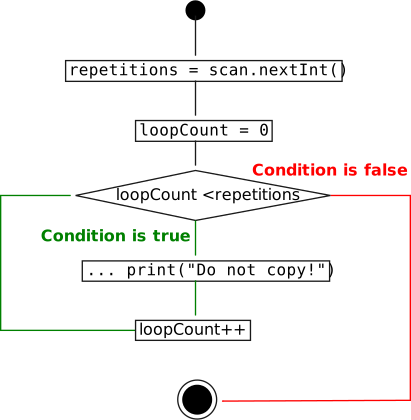
Figure 175. A while loop Slide presentation
final int repetitions = scan.nextInt();      
int loopCount = 0; 

while (loopCount < repetitions ) {            
   IO.println("Do not copy!"); 
   loopCount++; 
}
Do not copy!
Do not copy!
Do not copy!
A while loop

The code block will be repeated this number of times.

Helper variable keeping track of repetitions.

Condition to be checked prior each execution.

Code block of statement(s) to be repeated.

Helper variable being incremented during each iteration.


Figure 176. Combining increment and termination condition Slide presentation
Code Execution
IO.print("Enter repetitions: ");
final int repetitions = scan.nextInt();
int loopCounter = 0;

while (loopCounter++ < repetitions) {
   IO.println("Do not copy!");
}
Enter repetitions: 3   
Do not copy!
Do not copy!
Do not copy!

Figure 177. while syntax Slide presentation
while (booleanExpression)
   (block | statement)
This closely resembles:
if (booleanExpression)
   (block | statement)

Figure 178. Empty while body Slide presentation
int threeSeries = 1;

while ((threeSeries *=3 ) < 100);

IO.println(threeSeries);

Exercise:

  • Find the block or statement mentioned in the previous syntax diagram.

  • What output do you expect?


exercise No. 70

Generating square numbers

Q:

Write an application printing the first ten square numbers. The output should look like:

The square of 1 is 1
The square of 2 is 4
The square of 3 is 9
The square of 4 is 16
The square of 5 is 25
The square of 6 is 36
The square of 7 is 49
The square of 8 is 64
The square of 9 is 81
The square of 10 is 100

A:

int counter = 0;

while (counter++ < 10) {
  IO.println("The square of " + counter + " is " + counter * counter);
}

exercise No. 71

Calculating factorial

Q:

The factorial n ! of a given integer n is being defined as the following product:

n ! = n × ( n - 1 ) × × 2 × 1

In addition the factorial of zero is being defined as:

0 ! = 1

Implement a int factorial (int value) {...} method computing factorials, e.g.:

Code
IO.println(factorial(0));
IO.println(factorial(1));
IO.println(factorial(2));
IO.println(factorial(3));
IO.println(factorial(4));
Result
1
1
2
6
24

A:

int factorial (int value) {
    int product = 1;
    while (1 < value) {
        product *= value;
        value--;
    }
    return product;
}

exercise No. 72

Mitigating factorial overflow problems

Q:

The solution of Calculating factorial yields:

Code
IO.println("10: " + factorial(10));
IO.println("11: " + factorial(11));
IO.println("12: " + factorial(12));
IO.println("13: " + factorial(13));
IO.println("14: " + factorial(14));
IO.println("15: " + factorial(15));
IO.println("16: " + factorial(16));
IO.println("17: " + factorial(17));
Result
10: 3628800
11: 39916800
12: 479001600
13: 1932053504
14: 1278945280
15: 2004310016
16: 2004189184
17: -288522240

Actually 12! is the last correct value here. 13! = 13 × 12! equals 6227020800 but we see just 1932053504. Whats wrong here? Provide an enhanced solution.

A:

This is (again) an overflow problem. The largest possible int value is 2 31 - 1 or 2,147,483,647. Thus 479,001,600 or 13! still fits in nicely but 6,227,020,800 corresponding to 14! does not. We may use long instead:

long factorial (int value) {
    long product = 1;
    while (1 < value) {
        product *= value;
        value--;
    }
    return product;
}

This works well until including 20! and fails again for long overflow reasons starting from 21! :

18: 6402373705728000
19: 121645100408832000
20: 2432902008176640000
21: -4249290049419214848